AI & Tech Daily Briefing - June 20, 2026
AI & Tech Daily Briefing - June 20, 2026
Summary and Implications
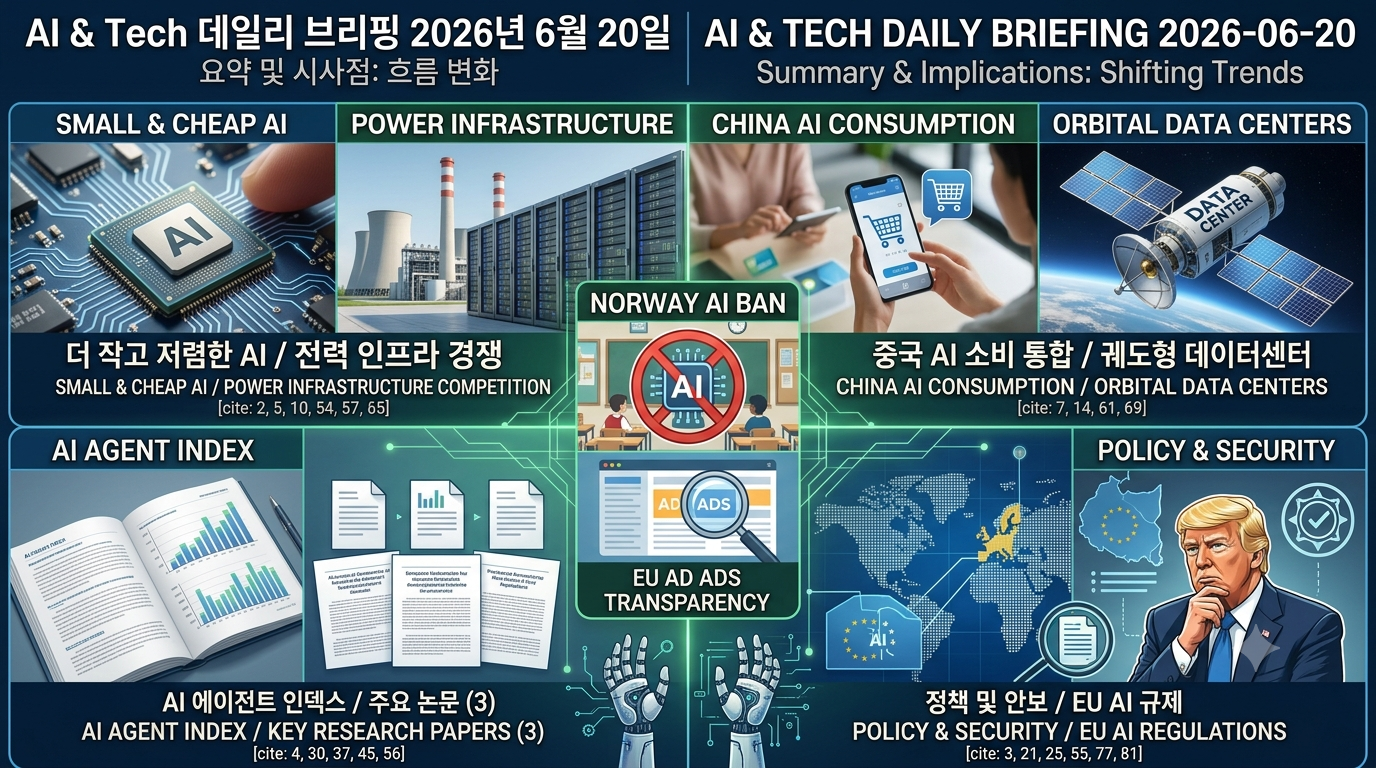
Current trends over the past three days indicate three key directions.
First, the focus of AI competition is shifting from "bigger models" to "cheaper and more efficient models and the infrastructure to run them."
Second, national policies and industrial strategies are beginning to address AI at a societal system level, extending to consumption, education, advertising, security, and data centers.
Third, in research, technical performance competition for AI agents is being eclipsed by core issues like safety, transparency, regulatory compliance, and evaluation in actual deployment environments.
Key AI & Tech News (7 Items)
1. Analysis Suggests Future AI May Be Small and Cheap
Title: The future of AI may be small, cheap and unprofitable
Summary: A Reuters commentary from June 18th notes that while the AI industry has grown under the "bigger is better" assumption, recent studies suggest smaller models can be competitive in cost-efficiency and commercial viability. This connects to concerns that an investment logic centered solely on ultra-large models could face profitability pressure in the long term.
Implications: The focus of AI model competition is likely to shift from parameter scale to inference unit cost, deployment efficiency, and optimization for specific tasks. AI service companies and infrastructure providers need to redefine their strategies around "cost-performance ratio" rather than just "top performance."
Publication Date: 2026-06-18
Source URL: https://www.reuters.com/commentary/reuters-open-interest/future-ai-may-be-small-cheap-unprofitable-2026-06-18/
2. China Announces Measures to Promote AI Integration with Consumption
Title: China announces measures to promote AI integration with consumption
Summary: According to Reuters, China announced policy measures on June 18th to integrate AI with the consumption sector. This demonstrates a policy direction of using AI not just as a technology industry, but as a catalyst for boosting domestic demand and industrial digitalization.
Implications: It is significant that AI strategies are being combined with national-level industrial and consumption policies. Korean companies need to monitor expanding strategies from China in AI services, retail, smart devices, and personalized experience markets.
Publication Date: 2026-06-18
Source URL: https://www.reuters.com/business/media-telecom/china-announces-measures-promote-ai-integration-with-consumption-2026-06-18/
3. Meta Reported to Sign New AI Computing Deal with Crusoe
Title: Meta signs new AI computing deals with data center firm Crusoe
Summary: Reuters reported on June 18th that Meta has signed a new AI computing deal with data center firm Crusoe. This shows that large model companies are competing not only on the models themselves but also simultaneously to secure power, servers, and data centers.
Implications: AI infrastructure competition is evolving beyond securing GPUs to make power procurement and data center partnerships critical variables. Competition among frontier model companies like Anthropic, Gemini, Meta, and OpenAI is increasingly becoming a combined battle for "model performance + power infrastructure."
Publication Date: 2026-06-18
Source URL: https://www.reuters.com/business/meta-signs-new-ai-computing-deals-with-data-center-firm-crusoe-bloomberg-news-2026-06-18/
4. Demand Rising for Insurance for Orbital AI Data Centers
Title: Space startups seek insurance for orbital AI data centers
Summary: Reuters reported on June 18th that space startups are seeking insurance for orbital AI data centers. Though in early stages, it signals that the idea of separating AI infrastructure from terrestrial power grid and cooling constraints has entered the commercial review phase.
Implications: While currently experimental, it shows a long-term scenario of AI infrastructure competition extending from terrestrial data centers to space infrastructure. As Physical AI and large-scale autonomous intelligence systems grow, the compute location and energy supply method itself can become a strategic asset.
Publication Date: 2026-06-18
Source URL: https://www.reuters.com/legal/transactional/space-startups-seek-insurance-orbital-ai-data-centers-2026-06-18/
5. Norway Pushing to Practically Ban Generative AI Use for Elementary School Students
Title: Reuters AI News page – Norway restricting generative AI use in schools
Summary: The Reuters AI section update from June 19th includes remarks from the Norwegian Prime Minister about almost completely banning generative AI use for elementary school students and limiting its use in higher education. The policy rationale is to prevent negative impacts on learning.
Implications: The strengthening of AI ethics and AI security regulations is spreading beyond corporations into the education sector. Companies providing Persona AI or learning-based AI services must prepare minor protection, human oversight, usage log management, and age-based restriction designs as basic requirements.
Publication Date: Based on June 19th updated page
Source URL: https://www.reuters.com/technology/artificial-intelligence/
6. EU Advertising Industry Argues for Exemption from Transparency Rules for AI-Generated Ads
Title: AI-generated ads should be exempt from EU transparency rules, retail association says
Summary: Reuters reported on June 19th that a European retail association argued AI-generated ads should be exempt from EU transparency rules. This shows the continuing tug-of-war between the industry and regulators regarding the obligation to label AI generations.
Implications: Issues of AI ethics, LLM bias prevention, consumer protection, and content provenance disclosure are likely to become core regulatory contention points for marketing automation and AI service expansion in the future. Especially for multimodal ad generation services, designing for "labeling obligations and liability attribution" might become more important than explainability.
Publication Date: 2026-06-19
Source URL: https://www.reuters.com/legal/litigation/ai-generated-ads-should-be-exempt-eu-transparency-rules-retail-association-says-2026-06-19/
7. President Trump Eases Remarks on Anthropic as National Security Threat
Title: Reuters AI News page – Trump no longer views Anthropic as a national security threat
Summary: The Reuters AI section update from June 19th reported remarks from US President Donald Trump saying that while he might have viewed Anthropic as a national security threat last week, he no longer does. This suggests frontier AI companies are being treated as direct variables in security policy, not just subjects of regulation.
Implications: AI strategy, Constitutional AI, and AI safety discussions are moving beyond corporate ethics frames into national security frames. Large model companies are in a phase requiring not just performance competition but also policy acceptability, safety explainability, and government relations capabilities.
Publication Date: Based on June 19th updated page
Source URL: https://www.reuters.com/technology/artificial-intelligence/
AI-Related Research Papers (3 Items)
1. The 2025 AI Agent Index: Technical and Safety Features of Deployed Agentic AI Systems
Authors: Staufer, L., et al. (2026)
Download URL: https://arxiv.org/pdf/2602.17753.pdf
Background: Agentic AI is spreading rapidly, but the documentation level regarding the capabilities, design, safeguards, and social impacts of deployed systems has been very uneven.
Purpose: The researchers aimed to build an index that systematically documents the origins, design, capabilities, ecosystem, and safety characteristics of 30 state-of-the-art AI agents based on public information and developer email communications.
Methodology: For 30 deployed AI agents, they created a comparable information structure through public data research and developer verification processes, analyzing the level of disclosure for technical features and safety information.
Results: The paper reported significant differences in transparency levels among developers, and that the majority did not sufficiently disclose information on safety, evaluation, or social impact.
Limitations: Since it relies on public information and developer responses, it may not completely reflect non-public deployment information or internal safety evaluation results.
Contribution: This paper provides a high-utility framework for both policy and industry by comparing the AI agent market including transparency, safety, and documentation levels, not just technical performance.
2. AI Agents Under EU Law
Authors: Nannini, L., et al. (2026)
Download URL: https://arxiv.org/pdf/2604.04604.pdf
Background: AI agents are expanding into customer support, hiring, clinical decision support, and critical infrastructure management, raising concerns that the EU AI Act alone is insufficient to describe actual regulatory compliance frameworks.
Purpose: This paper aims to present a regulatory map for AI agent providers by connecting multiple legislations including the EU AI Act, GDPR, Cyber Resilience Act, Digital Services Act, Data Act, and NIS2.
Methodology: They integrated draft standardization requests as of January 2026, the 2025 GPAI Code of Practice, CRA standard programs, and Digital Omnibus proposals to organize regulatory triggers by deployment type.
Results: The authors proposed 9 deployment categories and a 12-stage compliance architecture, identifying cybersecurity, human oversight, transparency in multi-party action chains, and runtime behavior drift as key regulatory challenges. They also concluded that high-risk agent systems exhibiting untraceable behavior drift would find it difficult to meet the essential requirements of the current AI Act.
Limitations: The legal and standard frameworks are changing rapidly, so some interpretations may vary depending on subsequent legislation or enforcement regulations.
Contribution: Highly valuable reference for corporate legal, security, and product teams by connecting strengthened AI security regulations and AI ethics issues to practical compliance design.
3. From LLM Reasoning to Autonomous AI Agents: A Comprehensive Review
Authors: Ferrag, M. A., et al. (2025)
Download URL: https://arxiv.org/pdf/2504.19678.pdf
Background: LLM-based reasoning and autonomous AI agents have advanced very rapidly, but benchmarks, frameworks, and collaboration protocols have developed disjointedly, leading to a lack of integrated understanding.
Purpose: This paper aims to organize benchmarks from 2019 to 2025, agent frameworks emerging after 2023, and agent collaboration protocols like ACP, MCP, and A2A into a single framework.
Methodology: The authors categorized about 60 benchmarks into general knowledge reasoning, math, code generation, factuality, domain-specific, multimodal/embodied tasks, task orchestration, and interaction evaluation, synthesizing major agent frameworks and actual application areas through literature review.
Results: The paper shows that autonomous AI agent research is expanding from single-model performance to multi-step decision-making, tool integration, multi-agent collaboration, and safety in real-world applications. Simultaneously, it presented advanced reasoning strategies, multi-agent failure modes, reinforcement learning-based dynamic tool integration, search coupling, and agent protocol security vulnerabilities as future research tasks.
Limitations: Due to the nature of a comprehensive review paper, weight is placed on systematic organization rather than experimental reproduction of individual frameworks or quantitative meta-analysis.
Contribution: Serves as a map providing an overview of benchmarks, harness engineering, autonomous intelligence, and AI agent protocols all at once, highly referable for both researchers and practitioners.
https://smartbus.tistory.com/m/129
https://smartbus.tistory.com/m/130
AI & Tech Daily Briefing - June 20, 2026
AI & Tech Daily Briefing - June 20, 2026Summary and ImplicationsCurrent trends over the past three days indicate three key directions.First, the focus of AI competition is shifting from "bigger models" to "cheaper and more efficient models and the infrastr
smartbus.tistory.com
https://couplewith.tistory.com/m/967
AI & Tech 데일리 브리핑 2026년 6월 18일
AI & Tech 데일리 브리핑 2026년 6월 18일요약 시사점최근 3일 기준 AI 이슈는 “에이전트의 실전 배치 확대”, “보안·접근통제 강화”, “AI 인프라와 서비스의 수익성 검증”, “정렬·벤치마크 연
couplewith.tistory.com